Philippa Fung

"Band-Aid on a gunshot wound"
Law and enforcement struggle to adapt as border crossings increase.
Overview
Record numbers of migrants have been crossing the southern border into the U.S. in the past few years. Communities across the country have felt the impacts of this, but the effects are especially clear in areas of the southwest where migrants must pass through. This project reports on the challenges that migrants face when coming into the United States, strains within Border Patrol and how immigration law is changing to try and find solutions.

Migrant crisis highlights challenges with immigration law
By Pippa Fung
PHOENIX – With the high rate of migrants that entered the United States in 2023, immigration law has had to evolve to accommodate for the amount of people waiting to file for asylum, most notably affecting processes like crossing the southern border and finding legal representation.
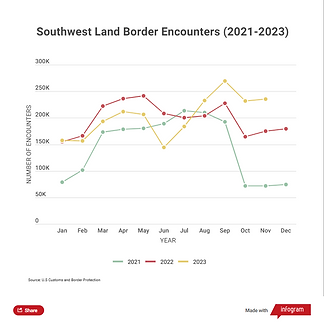
According to the U.S. Customs and Border Protection, around 2.5 million migrants were encountered at the border in FY2023. This was higher than the previous two years by nearly 100,000 people, preventing standard systems like filing for asylum from operating as usual. To combat this, governments have been discussing new legislation in hopes of streamlining this process, particularly at the border and in court; however, some worry that it will harm migrants more than it helps.
When migrants reach the border, they must be detained until they have a background check run on them. If everything goes smoothly, migrants should then be released with a Notice to Appear (NTA) providing a court date and address for them to defend their files for asylum.
However, one Arizona Border Patrol Tactical Unit (BORTAC) agent, who wished to remain anonymous in light of repercussions from his employment, said that this is not easy. Border Patrol facilities are “over capacity everywhere”, he said, and cartels have an increasingly harmful and invasive presence at the border as well.
READ MORE: Migrant Crisis Leads to Stress Within Border Patrol
From there, migrants must find representation to help them with their asylum claims in court. The Florence Immigrant and Refugee Rights Project, a non-profit organization in Arizona, aims to provide this.
Legal representation is a big challenge for migrants, explained Greer Millard, the communications manager at the Florence Project, as there are not enough attorneys to serve everyone. This means migrants often have to represent themselves, which is difficult if they do not know English or how the courts work.
Hillary Walsh, the founder and president of New Frontier Immigration Law, agreed, saying that the rate of migrants who won their court cases was so low because many of them did not have access to proper representative resources.
She added that this is exacerbated because people are only considered to be residents after staying in the United States for over 180 days. This leaves migrants unable to find work and therefore sustain themselves while filing for asylum, and they are ineligible for using government resources in the meantime.
The Florence Project provides legal services at detention centers, where migrants may be held until their court dates, and at the Migrant Welcome Center in Nogales, one of Arizona’s port of entries. There, migrants are often looking to reunite with family or sponsors elsewhere in the U.S., so instead of starting to represent them, the Florence Project gives consultations so that migrants can better present their own cases and has resources in Pima and Maricopa counties to do the same.
However, Millard said, this is not enough.
The Florence Project does not have the capacity to expand to other areas of Arizona where people may need legal assistance, and they are limited in what they can do for migrants until they are able to file for asylum, which can in itself be a long and arduous journey.
In response to the challenges that migrants face when coming to the U.S., state and federal governments have been discussing law changes that could alleviate pressure from the current immigration system.
In Arizona, a combination of Senate and House bills collectively referred to as the “Arizona Invasion Act” supported classifying illegal border crossings as state crimes, making the migrant crisis a criminalization defense issue instead of a deportation one.
However, the Florence Project is not qualified to work in criminal defense; furthermore, Millard said that “immigration law is federal law, and state level judges aren’t really qualified to adjudicate those types of cases.”
The “Arizona Invasion Act” ended up being vetoed by Gov. Katie Hobbs in early March, but Millard said that this still would have been “catastrophic” for the people they serve.
Regarding recent federal measures, such as the Senate supplemental bill, to increase border security and put more funding towards Border Patrol, the BORTAC agent said that “it seems like there are lawmakers who are just talking a big game”, as he often sees discussions of changing immigration law but rarely sees these changes around him in real life.
Walsh advocated for both making it easier to get a work visa in the U.S. and for more systemic change, reframing the migrant crisis to be viewed “as skilled workers who just want to come to work in the U.S.”
“Every law [for] such a modern and dynamic situation needs to be updated for the world we’re living in,” the BORTRAC agent said. But in the end, he suggested that until more diplomatic measures are taken to help the countries that migrants are fleeing from, “there isn’t any one solution. Just a lot of nuance in a lot of the situations at play.”


Close up view of the Arizona State Senate building, taken on April 12, 2024.
Outside of the Maricopa County Courthouse, taken April 12, 2024.
Audio slideshow on the challenges that migrants face when entering the United States.
Video on the process of resettling refugees into the U.S. and the cultural and legal changes that could be made to make this adjustment easier.
Migrant crisis leads to stress within Border Patrol
By Pippa Fung
PHOENIX -- As over two million migrants crossed over the southern border in 2023, Border Patrol has seen many changes in its day-to-day operations, unintentionally affecting migrants and Border Patrol agents in return.
Many border operations do not have the resources or staff available to accommodate for the current number of border crossings. Because of this, Border Patrol duties, which typically consist of surveillance and facilitating the flow of people and goods across the border, have also expanded to involve interviewing and processing migrants through detention. However, without enough trained employees to file migrants into the asylum system, conditions at the border are often harsh and not ideal for either Border patrol agents or migrants.
One BORTAC agent said that Tucson, where he is stationed, was suffering especially because it is a smaller processing point whose facilities were not meant to be permanent.
"At the end of the day," he explained, "we're not an agency that is equipped to house people long term."
He added that Border Patrol processing coordinator jobs had been created to alleviate weight from the Border Patrol, but he only ever saw three or four of these people a day, possibly because employers had a difficult time filling these positions.
This situation has also led to further challenges with cartels, the same BORTAC agent said, as they frequently exploit migrants by taking their documentation and requiring high fees for smuggling them into the country. People who do successfully make it across the border may then be on credit with the cartel for years after. This makes smuggling people more of a lucrative business for them than drugs or weapons.
"These are people just trying to come here for a better life, but the cartels are the ones benefitting from this...and [they] are essentially operating unabated," he said.
Hillary Walsh, an immigration lawyer in Phoenix, also said that as a result of the tough conditions and the amount of human suffering they see, the burnout rate of immigration lawyers at the border is often high, leaving migrants vulnerable and unable to find help in filing for asylum.
The BORTAC agent suggested that some of the government's more well-discussed potential solutions -- hiring more Border Patrol agents or putting more funding toward their institution for border security -- might be helpful but in the end would just be "putting a Band-Aid on a gunshot wound" until they can find a way to deal with the root problems of these changes, which are the issues that prompt migrants to flee from their home countries.
Greer Millard, who works for the Florence Immigrant & Refugee Rights Project, agreed, saying that federal policy changes would not properly help migrants who need a better place to live but cannot begin to file for asylum without aid.
"Neither of the political parties is really on the same page as [the Florence Project] in terms of how we'd like to see border management proceed," she said.


Outside view of Phoenix Sky Harbor Airport's U.S. Customs and Border Protection office, taken April 6, 2024.
Desert highway road outside of Phoenix, AZ, taken April 6, 2024.